
Finding Apex Residents by Record
An Apex residents directory search has no single official master list. The useful route changes with the question. A street address belongs first in the parcel and map systems. A current name may be checked against the North Carolina voter lookup, then separated from a property owner, a court party, or an old directory entry. For an older household, the cataloged suburban volumes, archives, and deeds carry more weight than a current administrative result. Each source should retain its own date and role.
Most Apex parcels route to Wake County, but the town crosses into Chatham County. The city line and ZIP code do not decide custody. Start with a delivery check and map layer, then use the parcel’s county to select the tax office, Register of Deeds, court clerk, and elections route. That simple split avoids looking for a Chatham-edge record in a Wake system, or treating a Wake mailing address as proof that a parcel is within town limits.
- Normalize the street number, directional, street name, unit, city, and ZIP. Keep alternate spellings and any older road name in the search notes.
- Use the USPS delivery check, the Town ZIP map, and a county map layer to identify the address geography before choosing a custodian.
- Search the Wake property system or Chatham parcel layer for the parcel key, physical address, owner-of-record label, and linked deed lead.
- Follow a named party to the appropriate Register of Deeds index, then use the public voter lookup or court portal only for the separate question each record can answer.
- For an historical name, inspect a dated directory, archive, or census item. If a defined record is not online, ask the holding office for that existing record rather than asking it to create a new list.
Apex Resident Records Offices
Different custodians answer different parts of an Apex residents search. The Wake Register of Deeds holds the larger town area’s recorded instruments, while Wake Tax Administration provides the current parcel snapshot. Chatham maintains parallel land and tax routes for the southeast edge. The Town Clerk is a separate municipal layer for minutes, historic town records, cemetery transactions, and requests. A full address-chain walkthrough belongs on the Apex street directory page, so the office list here stays focused on choosing the right doorway.
Wake Tax Administration
Current parcel, map, and value route
Wake County, NC
919-856-5400
North Carolina Elections
Statewide voter-record lookup
Choose Wake or Chatham by parcel
County route depends on address
Apex Parcel Searches Start the Directory Trail
Wake Real Estate Search is the strongest first stop for a Wake-side address. It separates a physical location from an owner’s mailing address and connects a parcel to its REID, PIN, acreage, map keys, sales, and deed links. The application is a current administrative snapshot, not proof that a named owner occupies the address or a complete history of the parcel. Near the county line, compare the result with Chatham’s GIS and land-record route before relying on the county label.
| Wake search route | Input needed | Useful result |
|---|---|---|
| Owner | Individual last name, with optional first or middle name | Current owner-of-record path |
| Location address | Street name required; street number optional; omit street type | Parcel candidates for an Apex address |
| REID | Seven-digit numeric identifier | One administrative parcel record |
| PIN | Map, block, and lot route with optional scale | Parcel map relationship and linked record |
Note: Wake lists values as of January 1, 2024 until its next revaluation, so the live parcel card remains the source for changed values.
The captured Wake property-search screen shows the official route used to turn an Apex address into a parcel key.
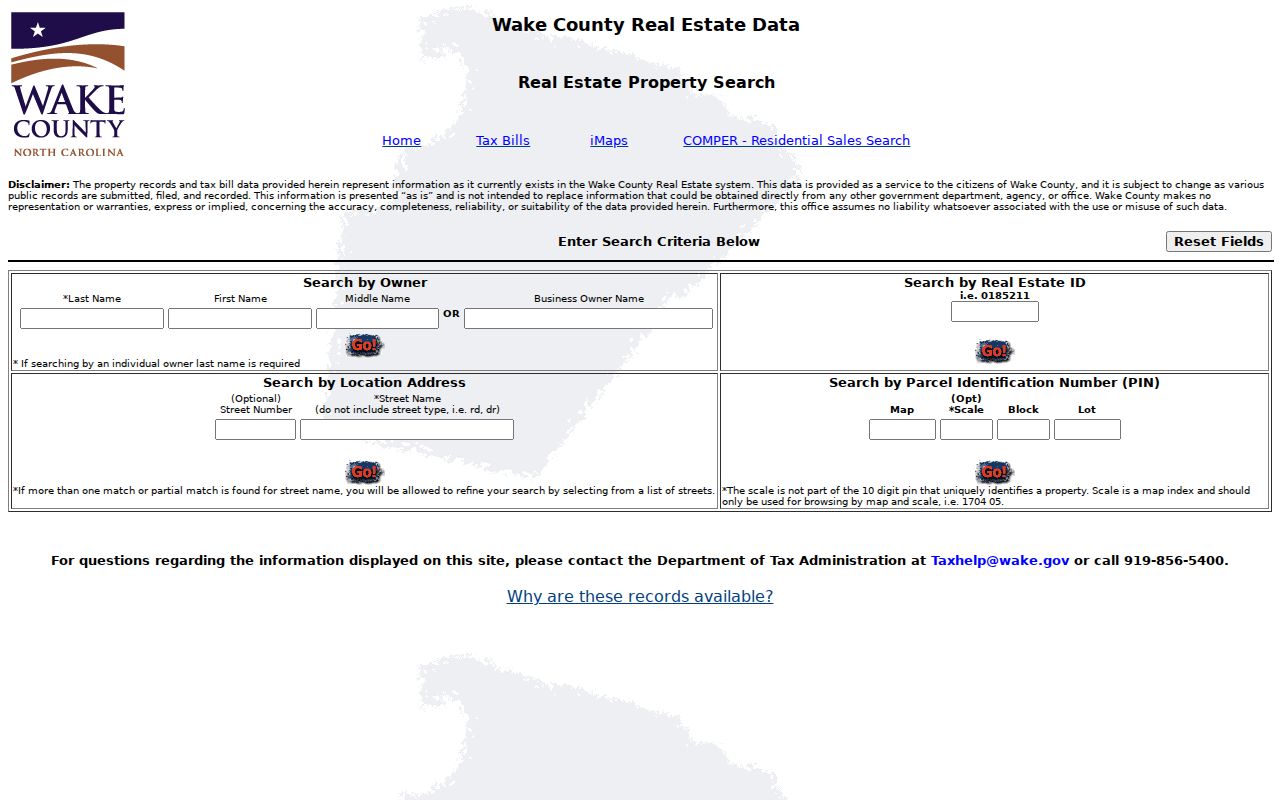
Use the returned REID or PIN as a bridge to the map and deed index, while keeping the assessor’s owner label distinct from a current-resident claim.
Apex Map Layers Check the County Line
Wake iMAPS supports address, street, owner, PIN, REID, place, and intersection searches. Once a parcel is identified, its layers can show streets, zoning, flood areas, school or polling information, soils, contours, aerial views, and historic imagery. The map links back to tax and deed research, but a visual parcel edge is not the legal boundary. A recorded deed or survey controls that question.
On the Chatham edge, the public parcel REST layer exposes physical street address, current and January 1 owner fields, deed and plat book/page, grantor, sale instrument, acreage, and legal description. It updates weekly and supports geometry and query controls. That parallel route matters because Apex has a Wake majority, not an all-Wake boundary.
The iMAPS parcel viewer image illustrates why a directory search should test the address geography before treating a postal city as a municipal record.
Directional variants, partial street names, and the street-name list can resolve an address that does not match the first spelling entered.
Current Apex Resident Records
Current Apex residents directories are record-specific, not interchangeable. The assessor records a parcel’s administrative owner label and address fields. The voter lookup is an election-record search. A deed index identifies parties to a recorded instrument, while municipal records document defined town actions. The Apex Neighborhood Registry gives association context, but it publishes no member roster. Treat every result as evidence of its stated record role and date.
| Source | Who It Lists | Keeper | Access |
|---|---|---|---|
| Wake or Chatham parcel record | Owner-of-record and parcel fields | County tax or GIS office | Official current portal |
| NCSBE Voter Search | Registered voter record and jurisdiction | North Carolina elections | Public lookup with protected fields |
| Recorded land index | Grantors, grantees, and instrument leads | County Register of Deeds | Online index plus request routes |
| Apex Clerk and Archive Center | Defined town records and historic municipal material | Town of Apex | Online archive or appointment |
| Neighborhood Registry | Eligible group context, not a roster | Town of Apex | Public registry page |
Use a parcel record for land identity, the election tool for a voter-record question, and a clerk or recorder for the official file. A commercial people-finder category can combine data from many dates, but it may omit the custodian, date, and limitation that make an official result useful. Direct official routes are usually free to search, although copies, certification, or extensive request work may have a fee.
| Official record routes | Show a source, office, date, and stated field set that can be checked again. |
|---|---|
| Commercial people-finder category | May be convenient, but can combine stale data and does not replace a custodian’s record. |
Apex Voter Results Need a County Check
The NCSBE Voter Search is a current name-to-jurisdiction tool, not a census of Apex residents. Its form requires first and last name and at least one voter status, with optional middle initial, birth year, and county. A result can show a voter’s jurisdiction, polling place, sample-ballot link when available, absentee information, and voter history. It does not establish ownership, a complete household, or a person’s full address history.
| Required search inputs | First name, last name, and a selected status of Registered, Removed, or Denied. |
|---|---|
| Useful optional filters | Middle initial, year of birth, and county help distinguish similar names. |
| Protected limits | Social Security and driver-license information are not public; protected voter addresses require suppression. |
The official voter lookup screenshot shows the narrow fields that keep an Apex name search tied to an election record rather than an assumed identity.
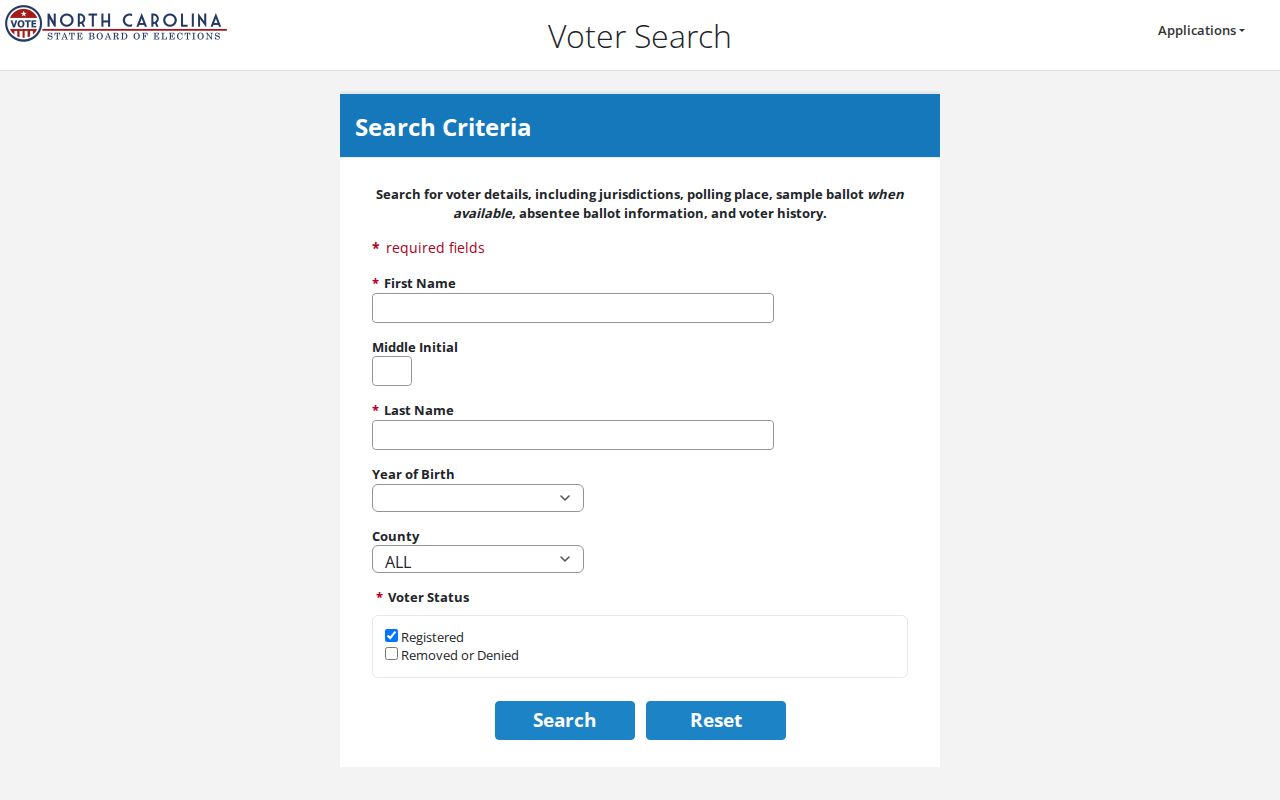
A no-result can reflect spelling, county, status maintenance, or address protection. Record it as a source gap, not proof that someone does not live in Apex.
Apex Court and Vital Record Trails
North Carolina eCourts is statewide, with Wake in District 10 and Chatham in District 18. Its public portal searches location, party, case type or status, filing-date range, and a date-of-birth filter, with separate hearings and judgment searches. A portal result is a docket lead. The county clerk’s file and public self-service terminal remain the route for the official record or certified copy.
NC Vital Records is an ordering and research gateway, not a name index. State coverage begins in 1913 for births, 1930 for deaths, 1962 for marriages, 1958 for divorces, and 2001 for fetal deaths. Certified copies are eligibility-controlled under Chapter 130A. Wake or Chatham Register of Deeds can route county-held certificates, while a divorce record goes through the county Clerk.
The eCourts portal is a public docket starting point for an Apex record question, not a substitute for the clerk’s file.
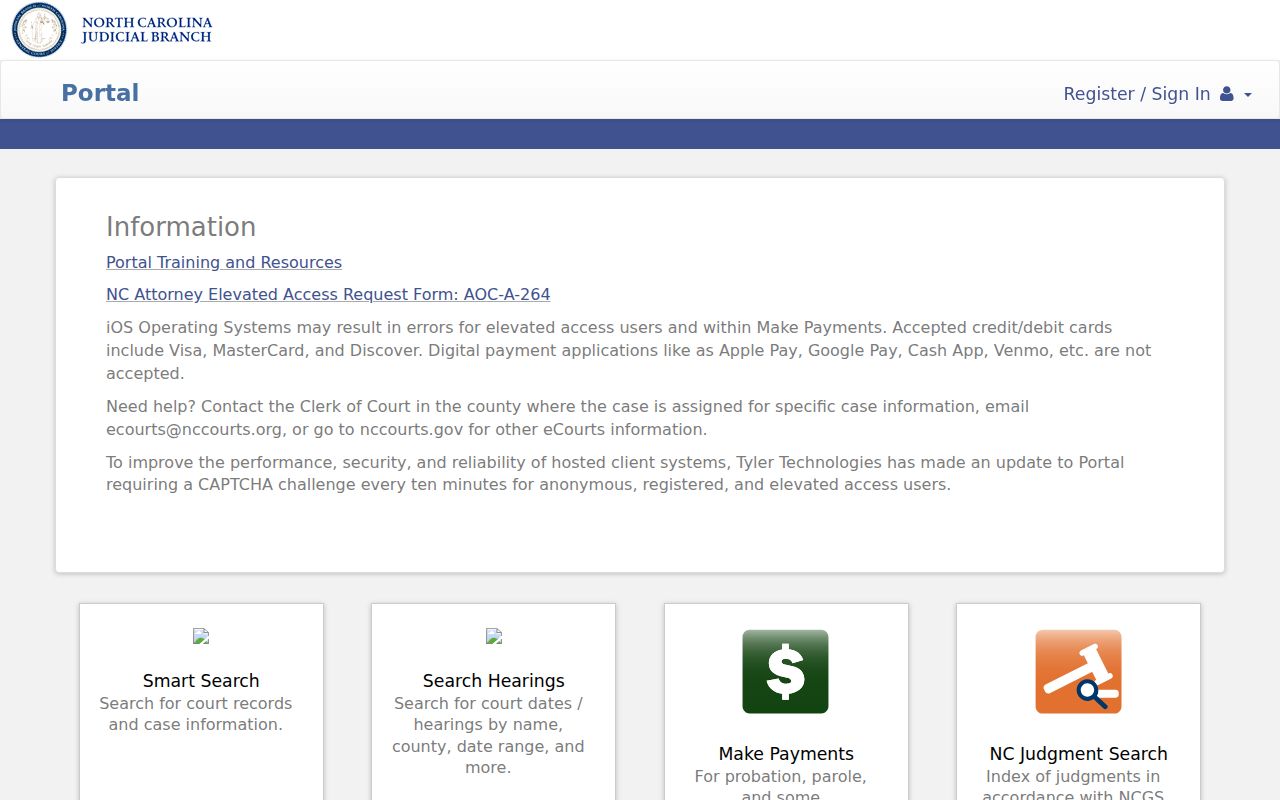
Use case number, party role, filing date, and official-result link as a concise record trail instead of copying a full docket.
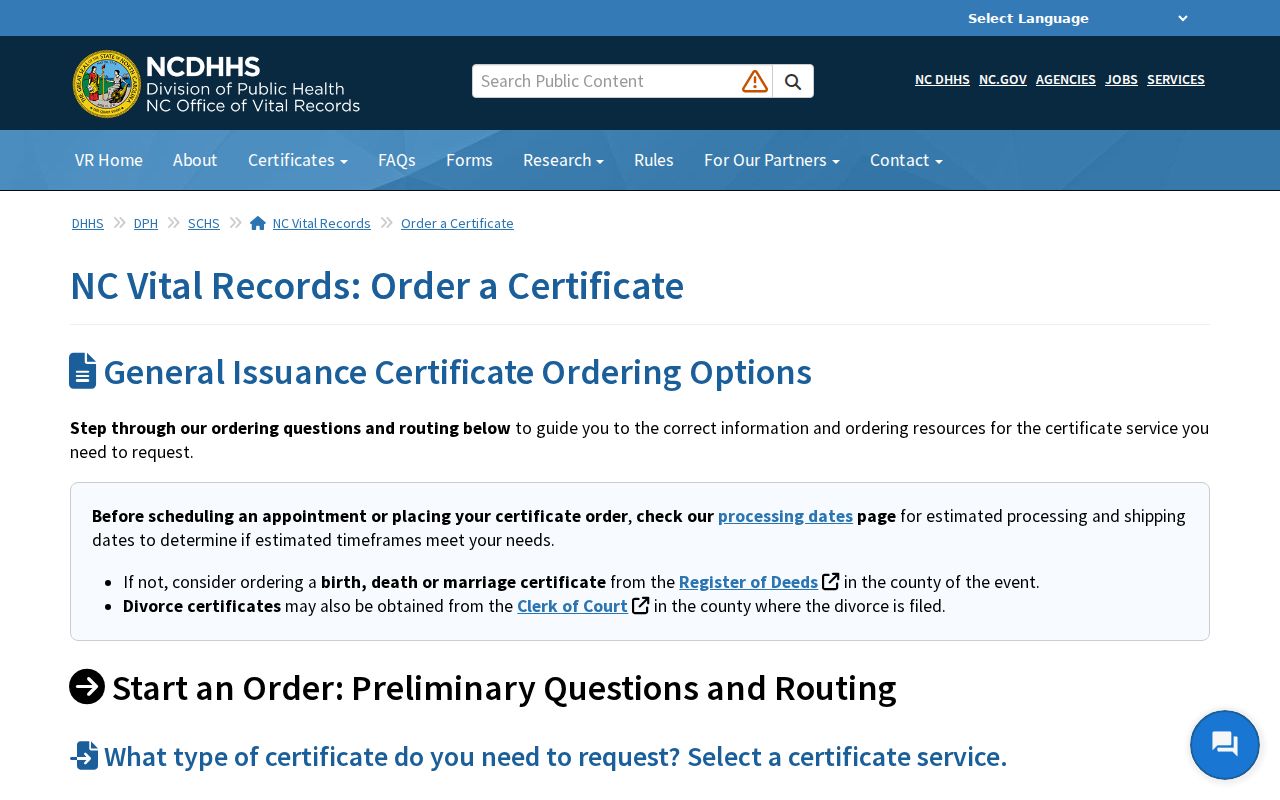
The NC Vital Records order screen identifies the event and relationship details a legitimate request must supply.
For older genealogy, use the state research route: pre-1913 births generally go to the county Register of Deeds, pre-1930 deaths to State Archives, pre-1962 marriages to the county Register, and pre-1958 divorces to the county Clerk.
Apex Record Requests Fill Online Gaps
When an official portal has no result, the fallback depends on the record. Wake’s recorded-document request form accepts document type, book and page, record date, grantor or grantee, property address, and subdivision or lot description. Its information desk is 919-856-5476, and the form provides mail and fax routes. The Town Clerk holds historical town records from the 1800s to the present by appointment at Town Hall, 73 Hunter St., with 919-249-1260 listed for contact.
The North Carolina Public Records Act, Chapter 132, supports inspection at reasonable times and prompt copies of existing records. GS 132-6.2 addresses electronic records and special-service costs for extensive work. A narrow request should name the agency, record type, date range, address, parcel, or case number and the preferred format. Neither an agency nor a county is required to create a compilation it does not maintain.
Note: Apex Council minutes are online for 1990–1994 and 2014–present, while earlier or missing years belong with the Clerk or Archive Center rather than an assumed absence of town action.
Apex History Changes a Name Search
Apex began as a railroad station chartered in 1854, received its first train in 1869, and incorporated in 1873. That history changes the vocabulary of an old-name search. A nineteenth-century source may use a county, depot, road, post office, or neighboring locality rather than today’s town label. The Town says its name reflects the highest point on the Chatham Railroad and the divide between the Neuse and Cape Fear drainage systems, useful clues when a modern address is absent from a historic source.
The Town’s records also document a practical naming quirk. Council approved “Squall Walden Lane” in 2022 after an earlier spelling appeared in records. Preserve both forms when a deed, permit, directory, or minutes search fails. A historical word is evidence, not a typo to erase.
Apex License Records Are Limited Leads
The North Carolina professional-license route points researchers to NCBOLD and the responsible licensing board. A board’s field set varies, so there is no single statewide person form. A public credential may support a narrow verification of the license type, status, number, and board, but it is not a general resident record and should never be used to infer an Apex address.
The official professional-license landing page is shown below as a routing tool, not as proof that a named license holder lives in the town.

For an assumed name or company mentioned in a deed or directory, the Secretary of State business search is another administrative lead, but a business address does not establish a person’s residence.
Historic Apex Directory Collections
The strongest local directory lead is the Wake County Libraries suburban-directory catalog, which explicitly includes Apex among the covered communities. It lists holdings for 1969, 1970, 1971, 1974, 1975, 1976, 1977, and 2021 volumes 1–3, with a series cataloged from 1975. Because these are regional books, inspect the locality index rather than assume a volume is Apex-only. Earlier Raleigh volumes at Olivia Raney Local History, digitized DigitalNC scans, Chatham microfilm, and State Archives collections form related branches for a dated name or address.
A printed entry can establish what appears in that volume and year: the exact name, locality heading, address or rural route, page or image, cross-reference, and perhaps a business or household heading. It cannot establish present residence or continuous occupancy. The full collection years, sample-entry method, and household-tracing process sit on the Apex city directory page.
- Parcel
- A tax or mapping unit with its own identifying key, not a statement that one named person lives there.
- Index
- A finding tool that points to a record. It is not necessarily the image or certified instrument.
- Criss-cross directory
- A reverse directory organized by street or address, useful for a dated location search.
- Roll
- A record list created for a defined purpose, such as tax administration or elections.
Apex Residents Have Privacy Boundaries
Public access does not permit a directory to defeat a protection program. The NC DOJ Address Confidentiality Program provides a substitute address for eligible survivors who relocate or are relocating. Voter addresses can also be protected under GS 163-82.10(e). Wake’s redaction process is for statutory protected identifiers in recorded documents, not ordinary disagreement with ownership history. Keep a suppression request with the custodian that holds the source record.
Lawful personal research. Use Apex records to understand a property, family history, an estate, civic record, or a defined public question. Do not use any result to stalk, harass, intimidate, or harm a person.
Ownership, voter registration, court parties, and historical listings are different facts. Pair sources when needed, preserve their limits, and stop when an official source does not expose the result required.